Restory Talks: The Unseen Presence – Archetypal Reuses of the Feminine in Shaping the Madonna della Misericordia
- March 22, 2026
- 0 Comment
The Restory Talks series continues in Cluj-Napoca, Romania, with a new invitation to explore cultural heritage through research, dialogue, and interdisciplinary perspectives.
As part of the Restory project, these encounters bring together researchers and practitioners who work with cultural heritage in different forms – from texts and oral histories to images and objects. Each talk opens a space to share methods, questions, and findings, while also creating a context for reflection and exchange between disciplines.
This time, the focus turns to the visual dimension of heritage and to a question that sits at the intersection of history, symbolism, and social meaning: how certain images persist across centuries through continuous reinterpretation, reshaping, and renewed meaning in different contexts.
A three-layered reading of a visual symbol
In this talk, Dr Ștefana Cristea proposes an original analysis of the iconography of Madonna della Misericordia, approaching it not simply as a medieval visual formula, but as the result of a complex process of reuse and reconfiguration of archetypal symbolic structures.
To understand this process, the research is structured across three interpretative levels.
At the deepest level lies the archetypal layer, inspired by the theory of Carl Gustav Jung. Here, the figure of the Virgin Mary is understood as concentrating a constellation of archetypes of the feminine – the Virgin, the Mother, the Protector, the Mediator, and, in certain Western contexts, the Queen.
At a second level, the visual form of the protective gesture is interpreted through the lens of cultural memory theory, particularly Aby Warburg’s concept of Pathosformel. This perspective allows us to understand how emotionally charged gestures persist and transform over time. The protective mantle of the Madonna can thus be related to other images of feminine protection, such as the wings of the goddess Isis or the veil of the Byzantine Theotokos.
Finally, the talk examines how these symbolic structures are reused and translated semiotically within specific social and cultural contexts. Drawing on Pierre Bourdieu’s concept of habitus, the analysis shows how the communities represented under the Virgin’s mantle reflect social hierarchies, patronage structures, and the visual codes of the medieval societies that produced these images.
Seen together, these layers reveal Madonna della Misericordia as a dynamic symbolic structure, in which archetypal meanings are continuously adapted and reactivated in response to the needs of different communities.
An invitation to reflect and engage
This Restory Talk opens a space for those interested in cultural heritage, visual culture, and interdisciplinary research to engage with a case that shows how images travel across time – and how they remain meaningful precisely through their capacity to change.
We invite researchers, students, and practitioners to join us for this conversation.
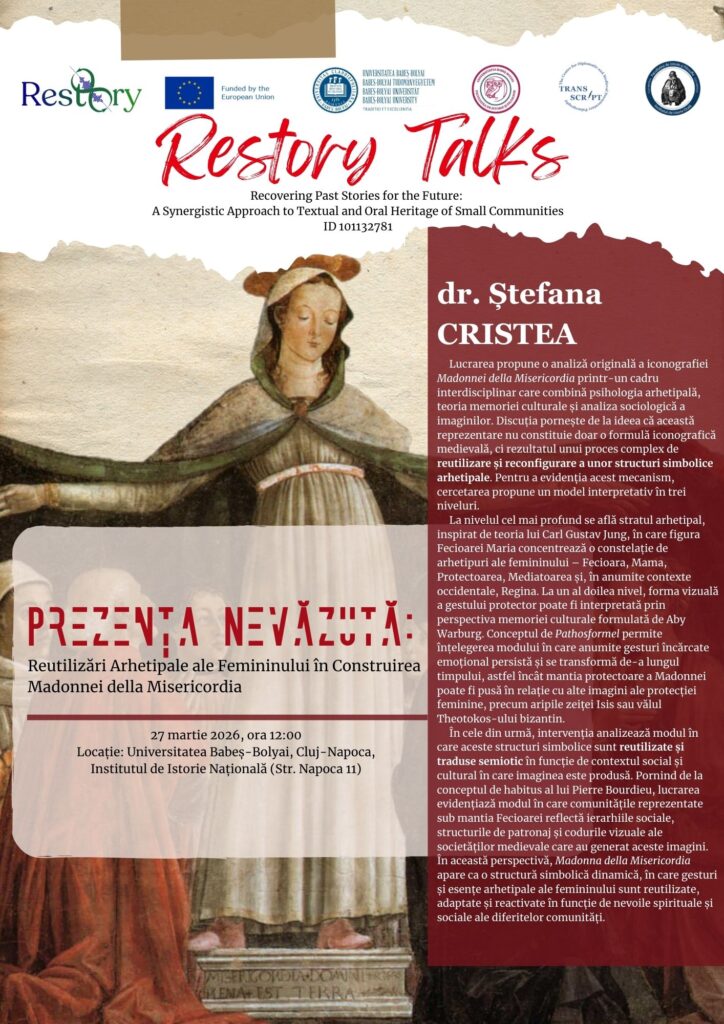
📅 27 March 2026, 12:00
📍 Babeș-Bolyai University, Cluj-Napoca, Institute of National History (Str. Napoca 11)
Our guest: Dr Ștefana Cristea
Ștefana Cristea is a historian and researcher, specialised in the study of visual culture and the symbolism of small-scale objects, particularly engraved gems, cameos, and personal artefacts with symbolic functions. Her research explores the relationship between images, archetypal structures, and the social context in which they are produced and used. She worked as an archaeologist for 25 years, and in 2012, she obtained her PhD in History from Babeș-Bolyai University with a thesis on Egyptian-origin divinities in Roman Dacia.
Her current academic activity focuses on how visual symbols and gestures are transmitted and reinterpreted across different historical periods, through an interdisciplinary approach that combines art history with perspectives from cultural memory theory, semiotics, and the sociology of art. In particular, she is interested in objects and images that function simultaneously as personal artefacts and as expressions of collective symbolic structures.
In 2022, she curated the exhibition “The Gods We Can Touch” at the National Museum of Banat in Timișoara and is the author of the catalogue of the museum’s collection of engraved gems and cameos, a work that combines cataloguing analysis with case studies dedicated to the cultural and historical meanings of these objects. She has published both archaeological works and studies addressing art and religions in the Roman Empire. In 2023 and 2025, she was awarded the “Vasile Pârvan” scholarship by the Romanian Academy, which gave her the opportunity to study in Rome in some of the most prestigious libraries, to participate in conferences, and to pursue her research topics in greater depth.
Her research interests include iconography from Antiquity to the present, the symbolism of the feminine in European visual culture, and the dialogue between European and Asian artistic traditions.