Restory launches its podcast series with a first conversation on heritage and identity
- March 22, 2026
- 0 Comment
The Restory project launches its podcast series with a first episode that brings research on cultural heritage into conversation with current societal questions.
The Restory Podcast: Stories from the Past. Ideas for the Future is designed as a space for dialogue with researchers working on cultural heritage, history, and related fields, connecting their work with broader themes relevant today.
A case that raises a fundamental question
The first episode focuses on Þingvellir National Park in Iceland, starting from a central question: If Þingvellir has “universal value”, how can it also be understood as “a shrine for the nation”?
The discussion explores how this heritage site is described, observed, and used, and by whom. It also places the case in a broader context marked by migration, globalisation, and changing understandings of national identity.
A recent increase in immigration to Iceland challenges the idea of a homogeneous national community and raises new questions about belonging. In this context, the episode asks whether Þingvellir can be reimagined as an inclusive cultural heritage site, rather than one where only those with deep historical roots feel at home.
Opening a space for discussion
The episode brings these questions into the discussion and reflects on their broader relevance, as well as the possible lessons to be drawn from this case for the future of cultural heritage.
The conversation features Guðmundur Hálfdánarson, professor emeritus of history at the University of Iceland, and is hosted by Paula Beudean (C.School), partners in the Restory project.
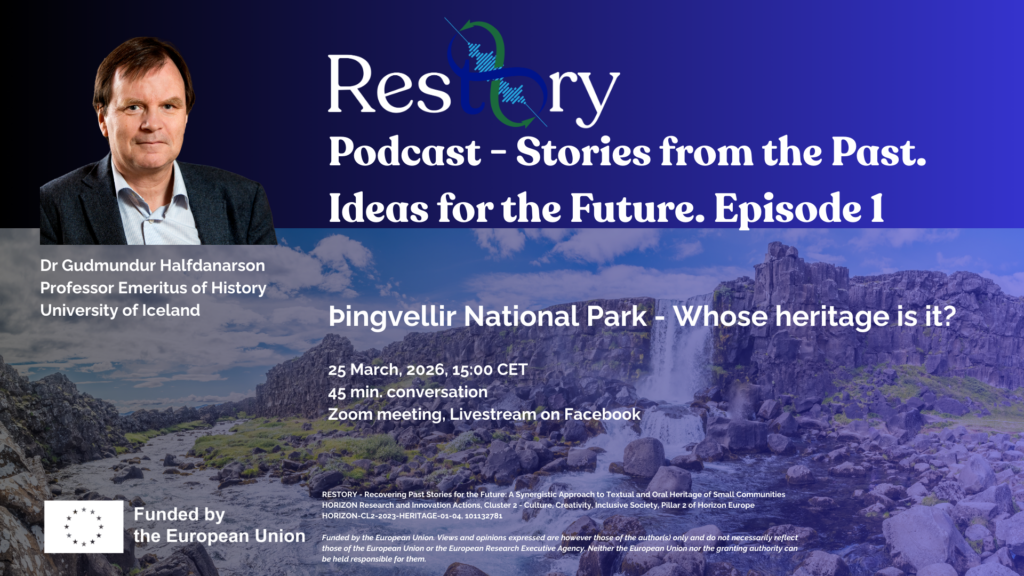
📅 25 March 2026, 15:00 CET
📍 Online (Zoom, live on Facebook )
About our guest
Guðmundur Hálfdánarson is a professor emeritus of history at the University of Iceland. He studied history and archaeology at the University of Lund in Sweden and at the University of Iceland, completing a doctoral degree from Cornell University in 1991. He specialises in European social and intellectual history, with special emphasis on the history of nationalism, the formation of identities, cultural heritage, and cultural memory.