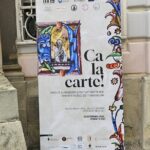
By the Book! – Reading, Knowledge and Community among the Transylvanian Saxons before the Modern Era
- September 21, 2026
- 0 Comment
By the Book! – an exhibition about the books, people, and communities of the Transylvanian Saxons in the Middle Ages
Opening: Tuesday, 22 September 2026, 1:00 p.m.
Venue: Brukenthal Palace, Hall of Columns (4 Piața Mare, Sibiu, Romania)
Exhibition period: 22 September 2026 – 21 March 2027
Press release
Presented in an original exhibition design and developed in collaboration with historians from Babeș-Bolyai University in Cluj-Napoca, By the Book! brings to Sibiu medieval manuscripts, printed books from the 15th and 16th centuries, documents, and fragments preserved today mainly in the collections of the Brukenthal National Museum — relics of a cultural universe now largely forgotten, yet still rich in lessons for the present.
What can books tell us today about the people who lived here 500 or 600 years ago, about their concerns and their joys? More than we might imagine.
In the churches, schools, and households of Saxon communities in Sibiu, Slimnic, Cristian, Cisnădie, Șura Mică, Dealu Frumos, the Bistrița area, and many other settlements across Transylvania, books were part of everyday life as early as the 14th century. They were read during church services, used in schools, consulted for administrative purposes, and passed down from one generation to the next.
The exhibition reveals the stories behind these dusty texts and offers details about the people who commissioned, read, and used them, as well as the journeys they took through time before reaching us.
Visitors will encounter books connected to specific places and circumstances: priests who built their own libraries, schools in need of textbooks and other texts, churches commissioning books for the liturgy, and craftsmen who transformed pages into genuine works of art. Some of these books are magnificent. Others appear entirely unremarkable. Some have survived almost intact; others have reached us only in fragments, reused in bindings or incorporated into other documents. Together, however, they preserve traces of the lives of the communities they once shaped.
By looking at these books in Sibiu, we can rediscover a medieval Transylvania that feels surprisingly close to us: a world deeply concerned with giving meaning and value to books, libraries, and school education.
The historical exhibition is complemented by interventions from contemporary Romanian artists whose work has been recognised and presented in both national and international contexts: Simina Oprescu, Ciprian Mureșan, Flavia Pitiș, Nicolae Romanițan, Emilian Pospaii, and Nicoleta Radu. Through visual and sound art, their works open up a dialogue between medieval book culture and questions of the present: how knowledge is transmitted, how information takes on a material form, and how objects become carriers of individual and collective memory. In this encounter, manuscripts, printed works, and historical fragments enter a living process of interpretation in which contemporary art brings heritage closer to the sensibilities of today’s audiences.
Partners: National Archives of Romania – Sibiu County Service; Romanian Academy Library – Cluj-Napoca Branch; Batthyaneum Library in Alba Iulia – Branch of the National Library of Romania; “Lucian Blaga” Central University Library in Cluj-Napoca; Cisnădie Fortified Evangelical Church; Teutsch House; Bistrița-Năsăud Museum Complex; National History Museum of Romania; National Museum of Romanian Literature Iași; Evangelical Parish C.A. Brașov.
The exhibition is part of the project Restory- Recovering Past Stories for the Future, funded under Horizon Research and Innovation Actions, Cluster 2 – Culture, Creativity and Inclusive Society, Pillar II of Horizon Europe.